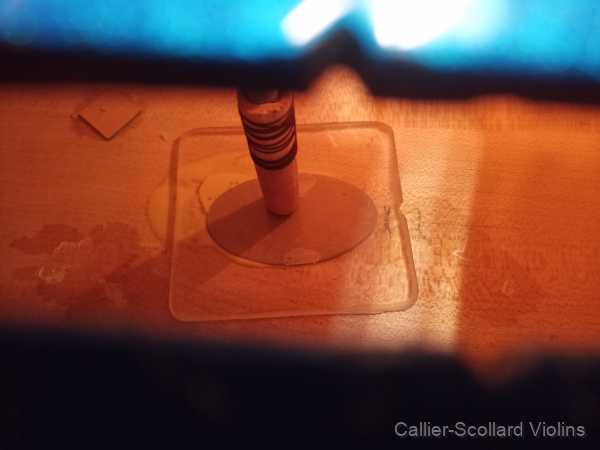
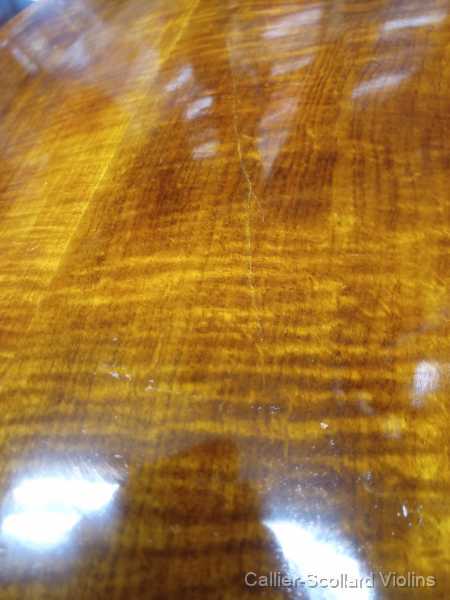
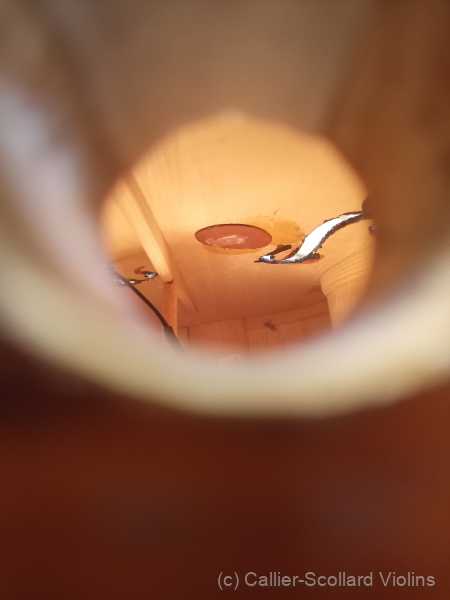
This rental cello came in with a severe soundpost crack in the top, along with an unusual diagonal fracture where two cracks intersected. Because the instrument is part of a rental fleet, the goal was to stabilize the damaged area and return the cello to reliable playing condition without undertaking a full internal restoration. The repair was carried out by carefully relieving pressure on the crack, gluing the fractures in stages, and installing a series of internal cleats through the f-hole to reinforce the area around the soundpost. Soundpost Crack Repair Steps- Relieve pressure on the crack: Open the lower top seam to reduce tension on the damaged area before beginning the repair.
- Perform a dry clamp test: Practice clamping the crack to ensure the alignment can be brought together properly.
- Glue the lower section of the crack: Apply strong glue to the lower portion of the crack and allow it to cure.
- Glue the remaining fractures: The following day glue the upper portion of the crack and the diagonal section where the two cracks meet.
- Clean the glue lines: Remove any excess glue and tidy the repair area.
- Determine the soundpost location: Place the broken bridge temporarily on the cello to determine the correct soundpost position.
- Install the first cleat: Position the first cleat so there will be adequate space for the soundpost.
- Set the clamp angle: Determine the correct angle required for the internal clamp to reach the cleat location through the f-hole.
- Prepare the cleat: Soak the cleat in water and temporarily glue it to the clamp using a small drop of CA glue.
- Apply wood glue to the cleat: Coat the cleat with wood glue for the permanent bond.
- Control glue flow: Lightly warm the glue with a heat gun to skin the surface so it will not drip during installation.
- Position the clamping mold: Set the external clamping mold in place to stabilize the top during the repair.
- Install the cleat: Feed the clamp and cleat through the f-hole, position it over the crack, and tighten the clamp.
- Allow the cleat to cure: Wait one day before installing the next cleat.
- Continue installing cleats: Normally cleats would be evenly spaced if the top were removed, but when working through the f-hole placement is partially limited by how the clamp can reach the area.
- Reinforce additional cracks: Glue the faint bass bar crack that was also present.
- Close the open seam: Reglue the previously opened seam once the structural repairs are complete.
- Touch up the varnish: Perform light varnish touch-up to protect the repaired area.
- Fit the bridge: Fit and install a bridge to complete the setup.
 IMG 20260228 151151 388 IMG 20260228 151151 388 | IMG 20260228 151225 908 | IMG 20260304 170111 101 | IMG 20260305 114340 662 | IMG 20260305 121939 335 | IMG 20260306 122314 610 | IMG 20260306 122359 703 | IMG 20260306 123803 033 | IMG 20260309 110649 287 | IMG 20260309 110824 991 | IMG 20260310 095355 596 | IMG 20260310 110202 380 | IMG 20260311 092558 539 | IMG 20260311 094547 066 | IMG 20260311 094807 580 | IMG 20260311 163950 172 | IMG 20260312 115250 267 | IMG 20260318 165832 343 |
After all of the cleats were installed and the cracks were stabilized, the repaired area felt solid and stable. Because this cello is part of a rental fleet, the goal was to restore reliable structural support around the soundpost rather than undertake a full restoration. By gluing the cracks in stages and reinforcing the area with internal cleats, the top was able to regain enough strength to safely support the soundpost again. Once the seams were closed, the varnish lightly touched up, and a bridge fitted, the cello was ready to return to service. |