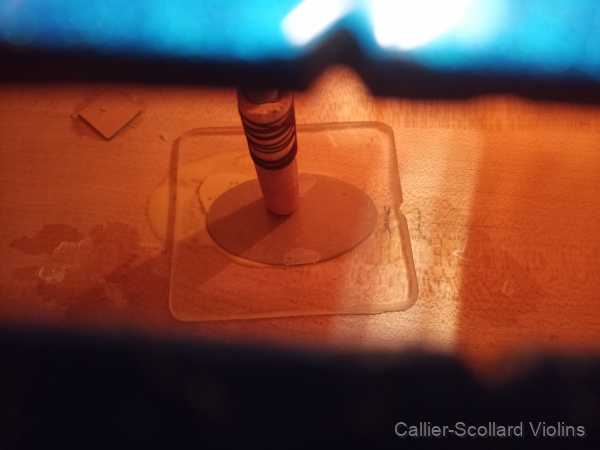
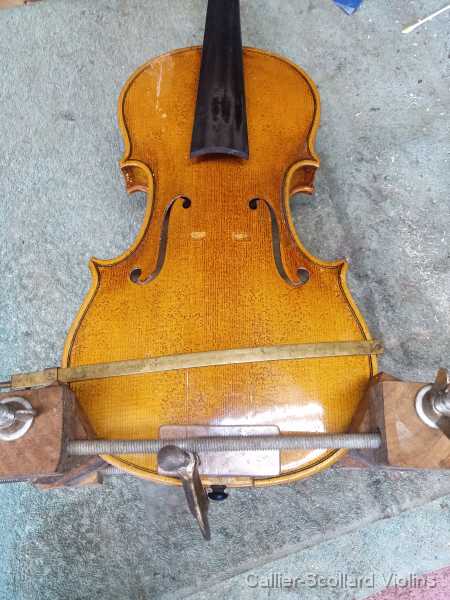
This violin came in with a top crack just below the left f-hole that did not align cleanly, leaving noticeable pressure along the joint. After carefully bringing the crack back into proper position, the next challenge was installing a larger cleat without slipping it between the rib and the top. The method shown here allows the cleat to be inserted and clamped entirely through the f-hole; a workable solution, but one that requires careful planning and precise execution for everything to seat correctly. - Clean the Crack: Carefully clean the crack to prepare the surfaces for proper alignment and gluing.
- Align with Mold: Make a mold to help bring the crack back into correct alignment.
- Lift and Position: Use two clamps and a soundpost setter to gently lift and position the uneven side.
- Clamp Laterally: Apply lateral clamping pressure to draw the crack together evenly.
- Plan the Cleat: After drying overnight and confirming alignment, determine the best way to install the reinforcing cleat.
- Prepare Thin Cleat: Make a thin wooden cleat that can be slipped through the f-hole.
- Create Internal Caul: Fabricate a small internal clamping surface so the cleat will fully conform to the top.
- Drill Guide Holes: Add two small holes to the internal clamping piece — one for wire and one for string removal.
- Attach Caul to Cleat: Use a small drop of CA glue to temporarily hold the internal clamping piece to the cleat.
- Bend Positioning Wire: Bend a wire so the cleat can be guided through the f-hole at the correct angle.
- Apply Glue to Cleat: Apply glue to the cleat. Tip: Lightly warming the glue with a heat gun helps prevent it from running off.
- Add Center Glue: Place a small additional dollop of glue in the center for full contact.
- Insert and Clamp: Fish the cleat into position and secure it with the first clamp.
- Remove Wire: Once clamped, remove the positioning wire.
- Remove Internal Caul: Pull the plastic internal clamping surface free using the attached string.
- Final Clamp: Attach the second clamp to complete the installation.
- Inspect Removal Piece: The final photo shows the internal plastic clamping surface after removal.
| | | | | | | |  IMG 20251213 164911 111 |
This violin had two significant cracks positioned closely together and near an older, previously repaired crack. A small piece of wood had become jammed between the newer cracks, preventing a proper glue joint. Rather than removing it, I carefully pried the wood back into alignment so the cracks could close properly. I glued each crack individually, then Working through the open lower left top seam, I installed two cleats spanning all three cracks for added stability. I also repaired a crack near the f-hole, reglued the seam, and touched up the repaired areas. With a bit of varnish left over, I took the opportunity to restore a missing section of varnish on the right side for a more complete finish. - Opened top seam: Accessed the repair area by opening the upper right seam of the violin.
- Leveled jammed wood: Carefully pried the jammed piece of wood back into position so the cracks could align properly.
- Glued cracks: Glued each of the two new cracks individually to ensure a strong bond.
- Installed cleats: Added two cleats spanning all three cracks to reinforce the area and maintain long-term stability.
- Repaired f-hole crack: Glued a nearby crack running from the f-hole.
- Closed seam: Reglued the opened seam after internal repairs were completed.
- Crack touchup: Lightly touched up the repaired cracks to blend them with the surrounding varnish.
- Varnish restoration: Used leftover varnish to restore a missing section on the right side of the violin.
| | | | | | | | | | IMG 20250530 133603 581 | |
. |