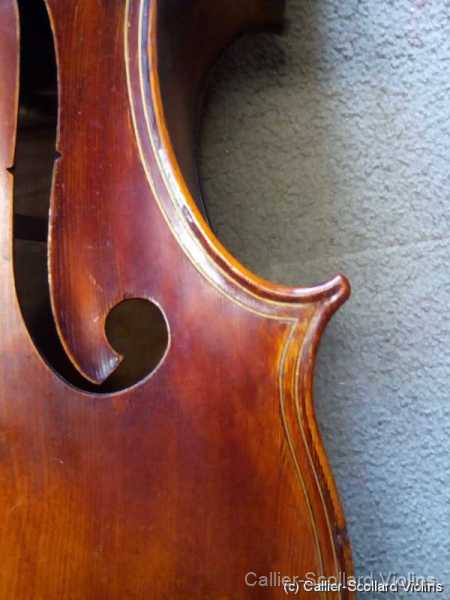
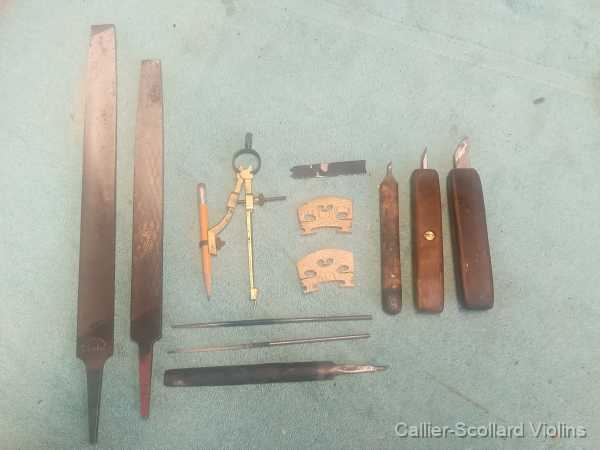
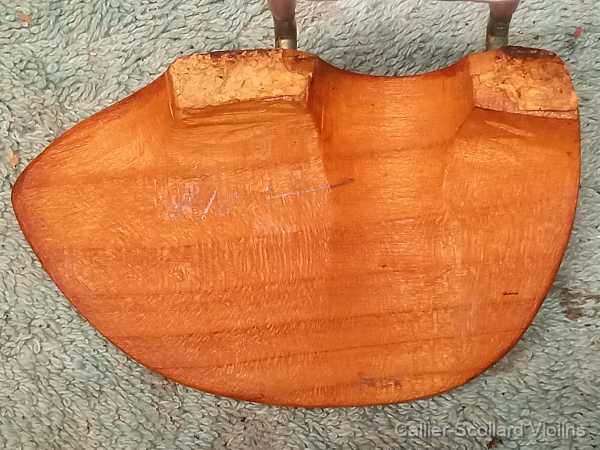
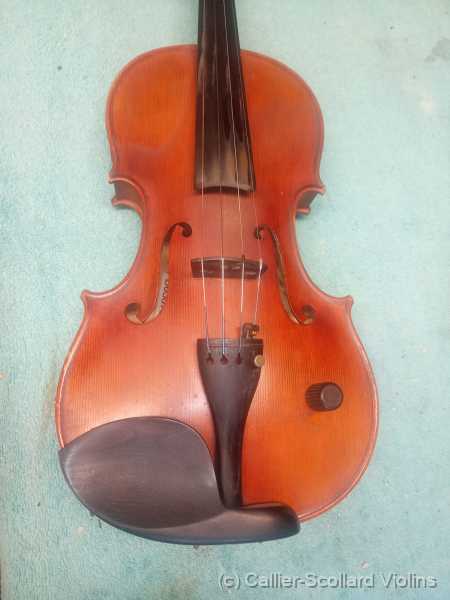
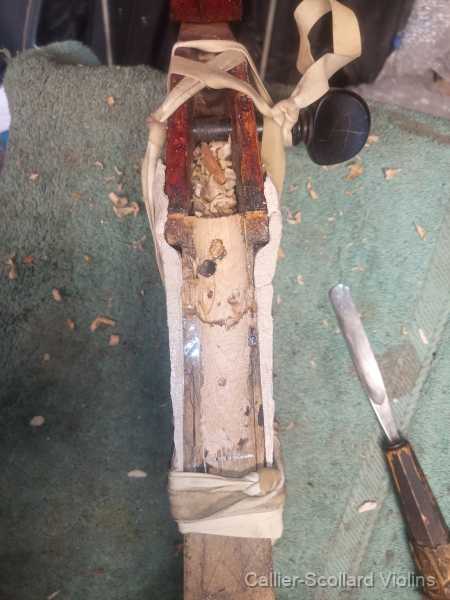
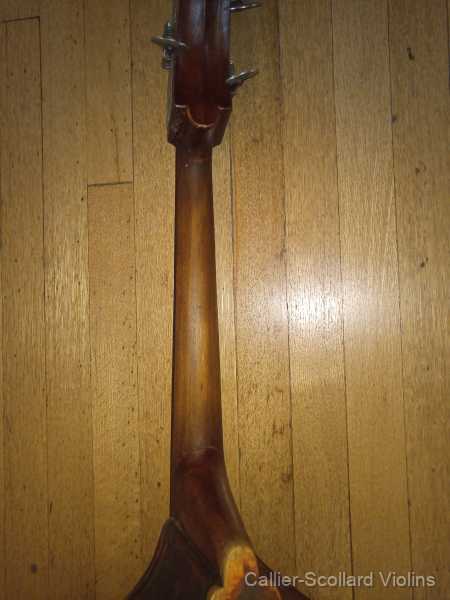
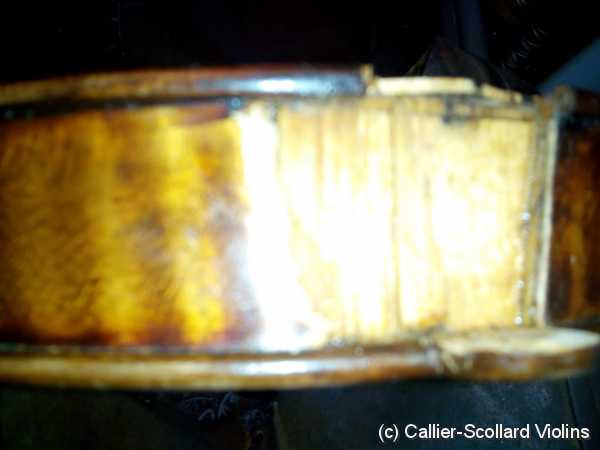
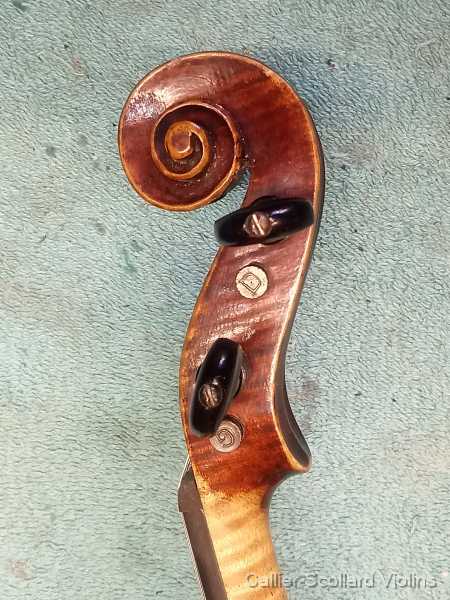
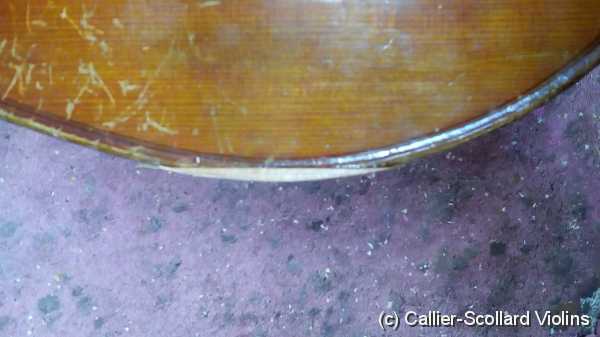
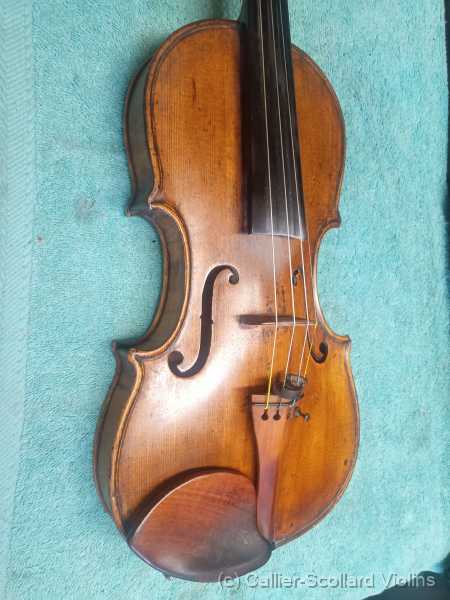
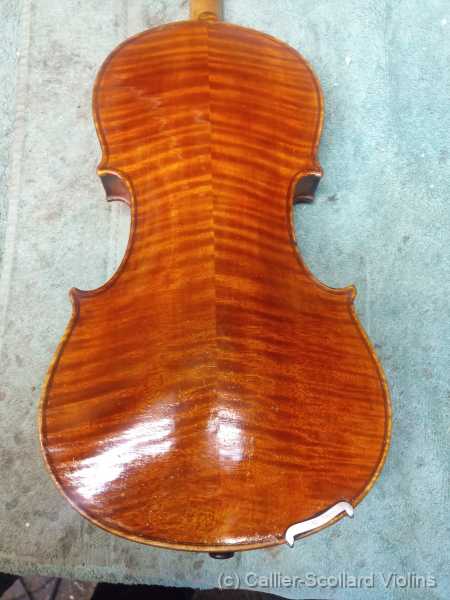
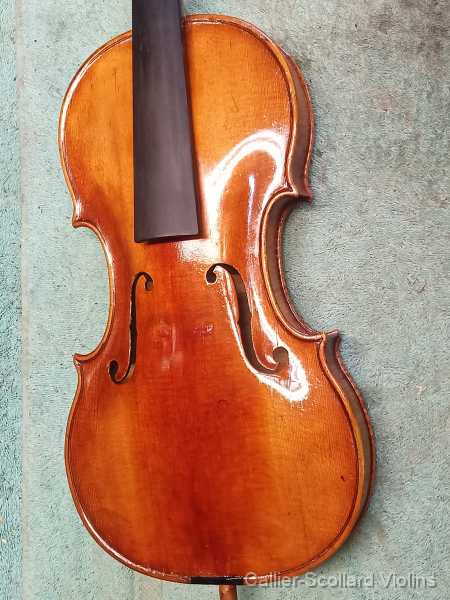
This violin was in the shop for new fittings, including new pegs, a new tailpiece, and a new end button. When fitting the new button, I found that the hole in the end block was slightly too large for the replacement part. The instrument had previously been bushed to correct an off-center hole, and that earlier repair was still working fine. In this case the goal was simply to reduce the diameter slightly so the new button would fit properly. A thin spiral bushing made from vulcanized fiber was fitted into the existing hole, allowing the diameter to be adjusted while keeping the hole centered and structurally sound before fitting the new end button. End Button Bushing Repair Steps- Estimate the required reduction: Determine approximately how much smaller the hole needs to be so the new end button will fit properly. In this case, one revolution of the spiral bushing was about right.
- Cut the vulcanized fiber strip: Cut the strip to length and taper both ends so they overlap smoothly while maintaining an even thickness.
- Create a tapered edge: The taper is formed similarly to the way a leather grip is prepared. A rounded mandrel makes it easier to shape the edges evenly.
- Sand the taper: Sand the edges of the vulcanized fiber until the taper fits smoothly and will form a clean spiral inside the hole.
- Set the depth of the bushing: Trim the fiber so the spiral will sit at the correct depth inside the end block.
- Glue the bushing in place: Use epoxy to secure the spiral bushing inside the hole.
- Protect the fitting with wrap: Wrap the peg with cellophane so it will not stick to the epoxy while being used to form the spiral.
- Press the peg into the spiral: Insert the temporary peg into the hole to shape and compress the spiral bushing as the epoxy cures.
- Trim excess material: The next day, remove the button and trim away any excess fiber from the bushing.
- Fit the end button: Perform the final fitting of the end button so it seats properly and holds securely.
 IMG 20260313 134328 432 IMG 20260313 134328 432 | IMG 20260313 135352 417 | IMG 20260314 132221 167 | IMG 20260314 132911 591 | IMG 20260314 133343 228 | |
The nice thing about a spiral bushing like this is that it strengthens the end block while still remaining practical for future work. Even though epoxy is used, the bushing can easily be removed later with a standard reamer if the hole ever needs to be refit.
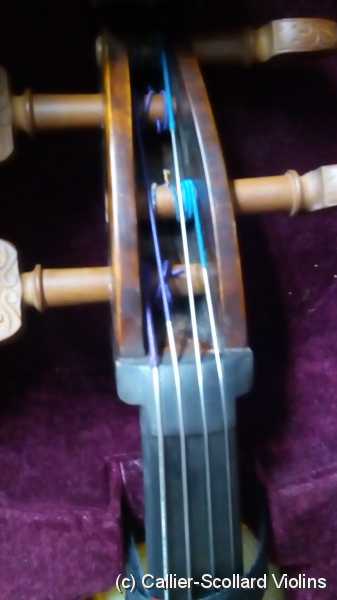
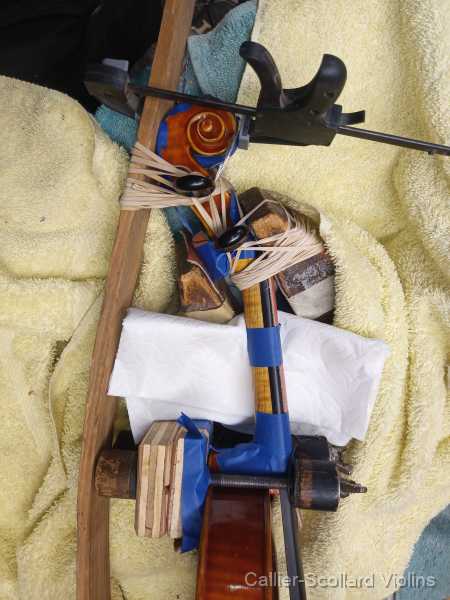
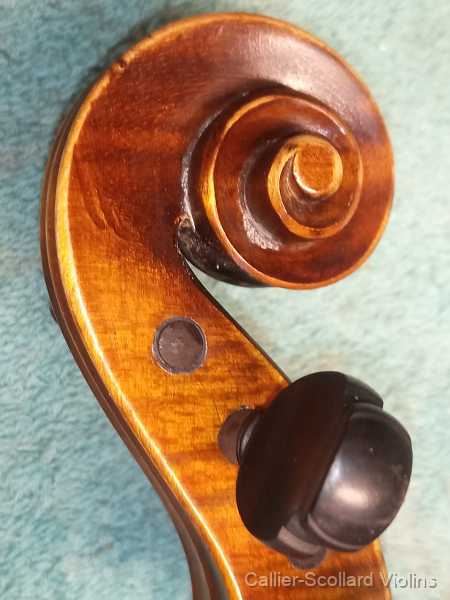
This violin also had an issue with the outside D peg hole, which had become slightly oversized. Reaming it further would have enlarged the hole too much, so the solution was to install a spiral bushing using the same basic method as the end button repair. Normally peg bushings require two wraps, but in this case the hole was only slightly oversized, so a single wrap was enough. IMG 20260306 161124 034 | IMG 20260306 161137 982 | IMG 20260314 133332 040 |
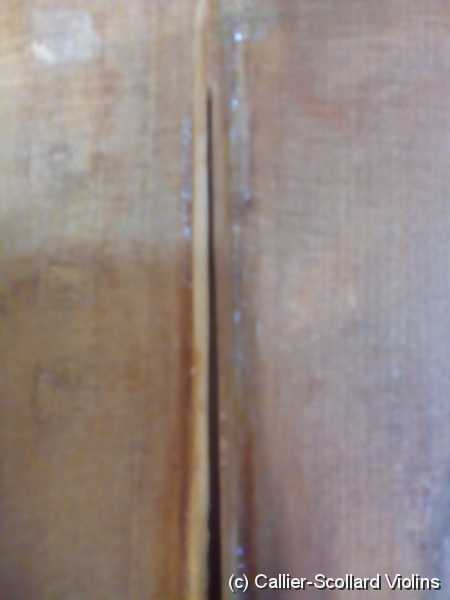
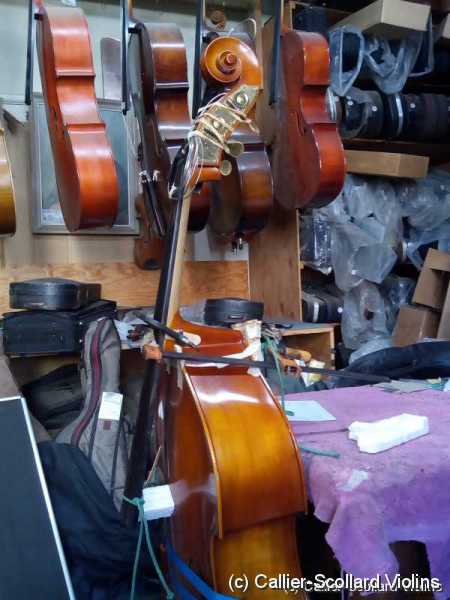
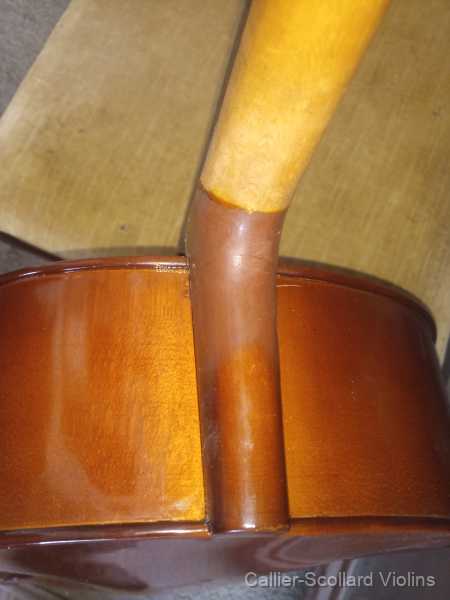
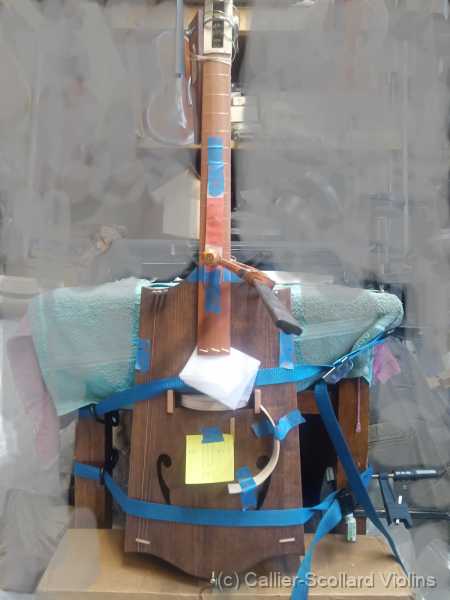
This cello was being fitted with a carbon fiber end pin, but the existing hole in the end block was slightly too small for the new hardware. Rather than ream the block larger, a thin spiral bushing made from vulcanized fiber was installed to create a clean, properly sized opening. A paper template was used to determine the correct length and angle of the spiral, allowing the bushing to fit neatly inside the hole before being glued in place. After the glue cured, the excess material was trimmed flush and the end pin was carefully hand fitted. Cello End Pin Bushing Steps- Create a paper template: Slip a small piece of paper into the end pin hole. Where the paper overlaps, draw a line to mark the correct length.
- Cut the template: Trim the paper along the marked line and press it back into the hole to confirm the length and angle are correct.
- Prepare the vulcanized fiber: Cut a strip of vulcanized fiber to match the paper template.
- Test the fit: Insert the fiber strip into the hole to make sure the angles and length are correct.
- Leave extra material for trimming: Allow the bushing to extend slightly beyond the outer edge so it can be trimmed flush later.
- Glue the bushing: Apply wood glue to the vulcanized fiber and place it into the hole.
- Form the bushing: Wrap the mandrel with cellophane so it will not stick, then drive it into the hole to press the spiral bushing firmly into place.
- Trim the excess: After the glue cures, trim off the excess fiber so the surface is flush with the ribs.
- Fit the end pin: Hand fit the end pin so it seats properly and holds securely.
IMG 20260306 120639 684 | IMG 20260306 120712 615 | IMG 20260306 134501 280 |
|